Greyhound Adoption: A Calm First 30 Days
- Make the first month predictable before making it exciting
- Before arrival, close the obvious escape routes
- Days one to three: reduce decisions
- Sleep is not an invitation to touch
- Days four to seven: establish a rhythm
- Build alone time in seconds and minutes
- Week two: add one variable at a time
- Weeks three and four: expand only what is working
- Arrange a breed-aware veterinary review
- Measure recovery, not obedience theatre
Make the first month predictable before making it exciting
During an adopted greyhound’s first 30 days, prioritise secure handling, a quiet bed, regular meals and toilet trips, short familiar walks, gradual introductions, and plenty of undisturbed rest. Treat the adoption or foster notes as the opening chapter, not a complete biography. The dog may have lived in racing kennels, a foster home, another household, or several environments, and previous experience varies.
The useful goal is not “fully settled by day 30.” It is a growing pattern of eating, sleeping, toileting, exploring, and recovering after mild surprises. A dog who naps in the living room and glances at the washing machine without filing an appeal is making real progress.
Adoption organisations use different screening, matching, home-visit, equipment, and follow-up processes. Follow your organisation’s contract and individual advice, especially for muzzles, other animals, fencing, and off-lead activity.
Before arrival, close the obvious escape routes
Walk through the home and garden as if you were a narrow, startled athlete who has never agreed to your floor plan.
- Check fence bottoms, side gates, loose panels, balcony gaps, and doors that do not latch.
- Ask household members to close exterior doors before opening an interior barrier.
- Put identification on correctly fitted walking equipment and confirm microchip transfer instructions.
- Block access to unsecured pools, steep drops, toxic plants, cleaning products, medication, food bins, and electrical cords.
- Add nonslip runners where hard floors create a skating rink.
- Mark large glass doors at the dog’s eye level until you know they are recognised.
- Use gates to limit stairs and introductions without isolating the dog completely.
Set up a main bed away from doorways and foot traffic. A wall behind it reduces approaches from the rear. Water should be easy to reach without passing an animal or object that worries the dog.
Have the greyhound collar or harness system fitted before the first outside trip. Greyhounds can back out of poorly fitted equipment, and “he seemed calm a second ago” is not an anti-escape feature.
Days one to three: reduce decisions
Bring the dog directly home rather than beginning with a parade of shops, relatives, and photogenic cafés. Show the toilet area on lead, then introduce one or two rooms and the bed. Offer water. Feed the diet and portion described by the adoption organisation unless a veterinarian has directed a change.
Keep voices and movement normal but low-key. Constant hovering can be as difficult as chaos. Let the dog approach and retreat; toss a treat near you instead of repeatedly reaching over the head. Avoid hugging, crowding, face-to-face contact, or inviting visitors to test whether “greyhounds are really that gentle.” No breed slogan can consent for an individual dog.
Take toilet trips at predictable times: after waking, after meals, before bed, and whenever pacing, sniffing, or circling suggests a need. Use the same exit and a quiet location at first. Praise outdoor toileting calmly. If an accident happens, clean it and adjust the schedule; punishment teaches only that humans become strange around puddles.
Short on-lead walks on a familiar route provide toileting, sniffing, and information. They do not need to establish a personal distance record. Monitor the dog’s feet, gait, breathing, interest, and recovery, particularly in heat or cold.
Sleep is not an invitation to touch
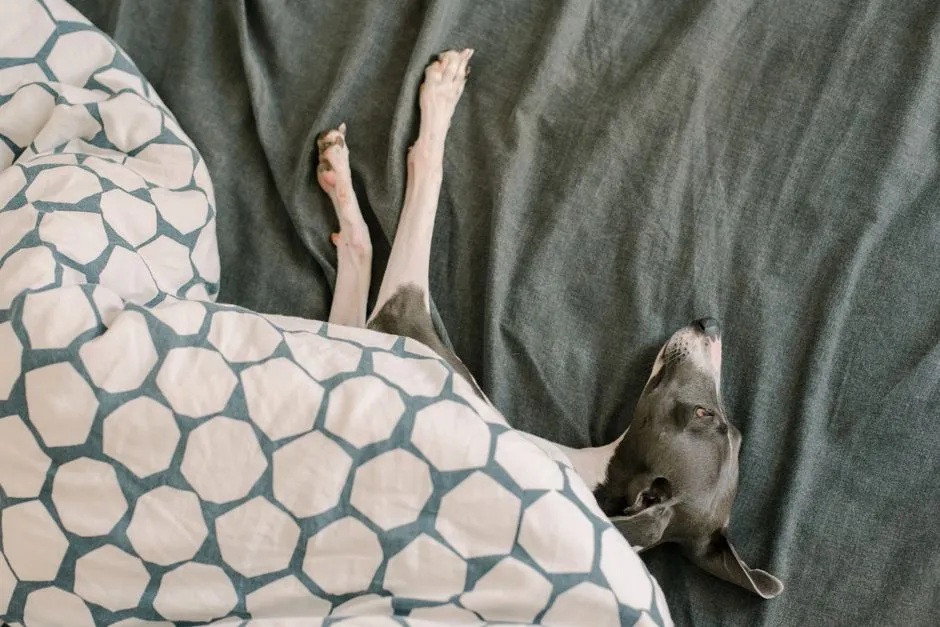
Newly adopted dogs may sleep deeply after the stress of transport and environmental change. Some greyhounds show a defensive response when suddenly touched awake. Give the dog a protected rest zone, keep children and other animals out, and wake from a distance with a consistent voice cue before inviting contact.
Our full guide to greyhound sleep startle explains bed placement and household rules. Use those precautions whether or not the adoption notes mention an incident. Respecting sleep costs nothing and avoids conducting your risk assessment beside a startled mouth.
Night-time arrangements should be simple. A bed near the household may help some dogs; others rest better in a quiet adjacent area. Use gates or closed doors according to the dog’s comfort and safety. Do not assume that previous kennel experience means a household crate will feel familiar. A dog panicking in a crate can injure itself.
Days four to seven: establish a rhythm
Write down meal times, toilet trips, stool quality, medication, walks, periods alone, and notable reactions. A brief log reveals patterns that memory turns into fog. It also gives the adoption organisation or veterinarian more useful information than “she was weird Tuesday.”
Begin three tiny pieces of reward-based training:
- Say the dog’s name once and reward a glance toward you.
- Reward four paws staying behind the threshold while a door opens slightly.
- Toss a treat onto a mat and calmly reward settling there.
Practise for one or two minutes in a quiet room. Stop while everyone still appears competent. Training early in adoption should create communication, not demonstrate how much curriculum fits into a biscuit.
Introduce household sounds at a distance and low intensity. Vacuum cleaners, television, doorbells, kitchen appliances, stairs, and slippery floors may be ordinary or entirely new. Never drag the dog toward a feared object. Increase distance, add traction, use food if the dog can comfortably eat, and try again later.
Build alone time in seconds and minutes
Even when someone can stay home during the transition, practise brief, easy separations before absence becomes unavoidable. Start while the dog is relaxed: step through a gate for a few seconds, return without ceremony, and gradually vary the duration.
Use a camera if possible. Panting, pacing, drooling, vocalising, frantic scratching, destruction near exits, toileting, or inability to settle can indicate separation-related distress. Do not “let the dog cry it out.” Reduce the duration to one the dog can manage and seek help from the adoption organisation, veterinarian, or qualified reward-based behaviour professional.
A food toy helps only if the dog can eat when alone and uses it safely. Refusing a favourite food is information, not ingratitude. Crating is not a universal treatment and can intensify panic in an unconditioned dog.
Week two: add one variable at a time
Once eating, toileting, and rest are becoming predictable, add controlled experiences slowly. Choose a quieter street, one calm visitor, a brief car trip, or a new room—not all four before lunch.
Ask visitors to ignore the dog initially. They can sit sideways and toss treats without reaching. Let the dog choose proximity. Stop the interaction if the dog freezes, turns away repeatedly, licks lips, pants without heat, tries to leave, growls, or cannot take food it normally wants.
Supervise children directly. Teach them never to enter the dog’s bed, hug, ride, corner, wake, or take food and toys. “Gentle child” and “gentle dog” are descriptions, not barriers. Physical separation is appropriate whenever an adult cannot actively watch.
For resident dogs, use the adoption organisation’s introduction plan. Parallel outdoor walking with distance can be easier than a doorway greeting. Remove food, chews, and prized toys initially. Separate for feeding and rest. A wagging tail does not guarantee comfort, and one friendly meeting does not establish unsupervised safety.
Cats and small animals require individual matching and a structured plan. Some greyhounds can live safely with them; others cannot. Muzzles reduce bite risk but do not prevent chasing, collision, or distress, and they do not replace barriers and supervision.
Weeks three and four: expand only what is working
Gradually lengthen walks according to health, weather, paw condition, and recovery. Greyhounds are capable sprinters, but a racing past does not prove current stamina or healthy joints. Repeating a familiar route can build confidence while you practise attention, loose-lead walking, and calm pauses.
Keep the dog on lead unless you are in a securely enclosed area and operating within local law, contract terms, and professional advice. Movement at distance can trigger pursuit before a human has completed the sentence “Normally she never—”. Recall is trained behaviour, not an aura generated by affection.
Add enrichment through sniffing, food searches, simple toys, and short training. Introduce each item under supervision. Some dogs have never encountered a squeaker, food puzzle, or object expected to be chewed politely rather than professionally dismantled.
Continue easy alone-time practice and occasional calm visitors. If progress stalls, lower difficulty instead of applying pressure. A dog who was shut down in week one may begin showing preferences, frustration, or prey interest later. This is not necessarily regression; feeling safe enough to express behaviour gives you better information.
Arrange a breed-aware veterinary review
Schedule a routine appointment soon after adoption using the timing advised by the organisation and clinic. Bring every available record: vaccination, parasite prevention, microchip, medication, allergy, weight, diet, dental work, injuries, surgery, laboratory results, and previous anesthesia.
Our greyhound vet-care guide explains why breed-aware laboratory interpretation, temperature management under anesthesia, thin skin, dental health, nails, and pain history deserve discussion. It does not replace the examination.
Contact a veterinarian sooner for wounds, lameness, persistent appetite loss, repeated vomiting or diarrhoea, coughing, urinary changes, pain, or marked lethargy. Breathing difficulty, collapse, uncontrolled bleeding, serious trauma, seizures, or a swollen abdomen with repeated unproductive retching require emergency advice.
Do not begin supplements, pain medicine, sedatives, parasite products, or diet changes based only on a greyhound group post. Human medication can be toxic to dogs, and even canine products need individual dosing and interaction checks.
Measure recovery, not obedience theatre
At day 30, ask practical questions:
- Can the dog eat and rest on a normal day?
- Are toilet signals and routines becoming clearer?
- Can the dog recover after a door closes, a truck passes, or a visitor enters?
- Which surfaces, sounds, animals, handling, or separations remain difficult?
- Does equipment stay secure through backing, turning, and mild surprise?
- Are there health, pain, dental, skin, nail, or gait concerns for the veterinarian?
- What conditions help the dog learn?
Keep successful routines and choose the next smallest useful challenge. The first month is not a deadline for becoming a finished pet. It is the period when the household learns the dog’s language, the dog learns the household is predictable, and everyone discovers that a greyhound can occupy an implausible amount of sofa while technically being very narrow.